
Practical, responsible and sovereign AI adoption
Generative AI is becoming part of everyday work. But for many organizations, adoption is still fragmented: tools are used individually, workflows are not shared, and decisions about data, models, cost and compute often remain unclear.
The GenAI Stack is an initiative for making generative AI adoption more practical, responsible and sovereign.
It helps organizations move from scattered experimentation to a shared foundation for working with AI: technically, organizationally and strategically.
The initiative is designed for organizations that want to move beyond isolated AI experiments and build a more responsible foundation for AI adoption. It is especially relevant for companies, public organizations, education partners and business networks that need practical access to AI while maintaining control over data, workflows, cost and learning.

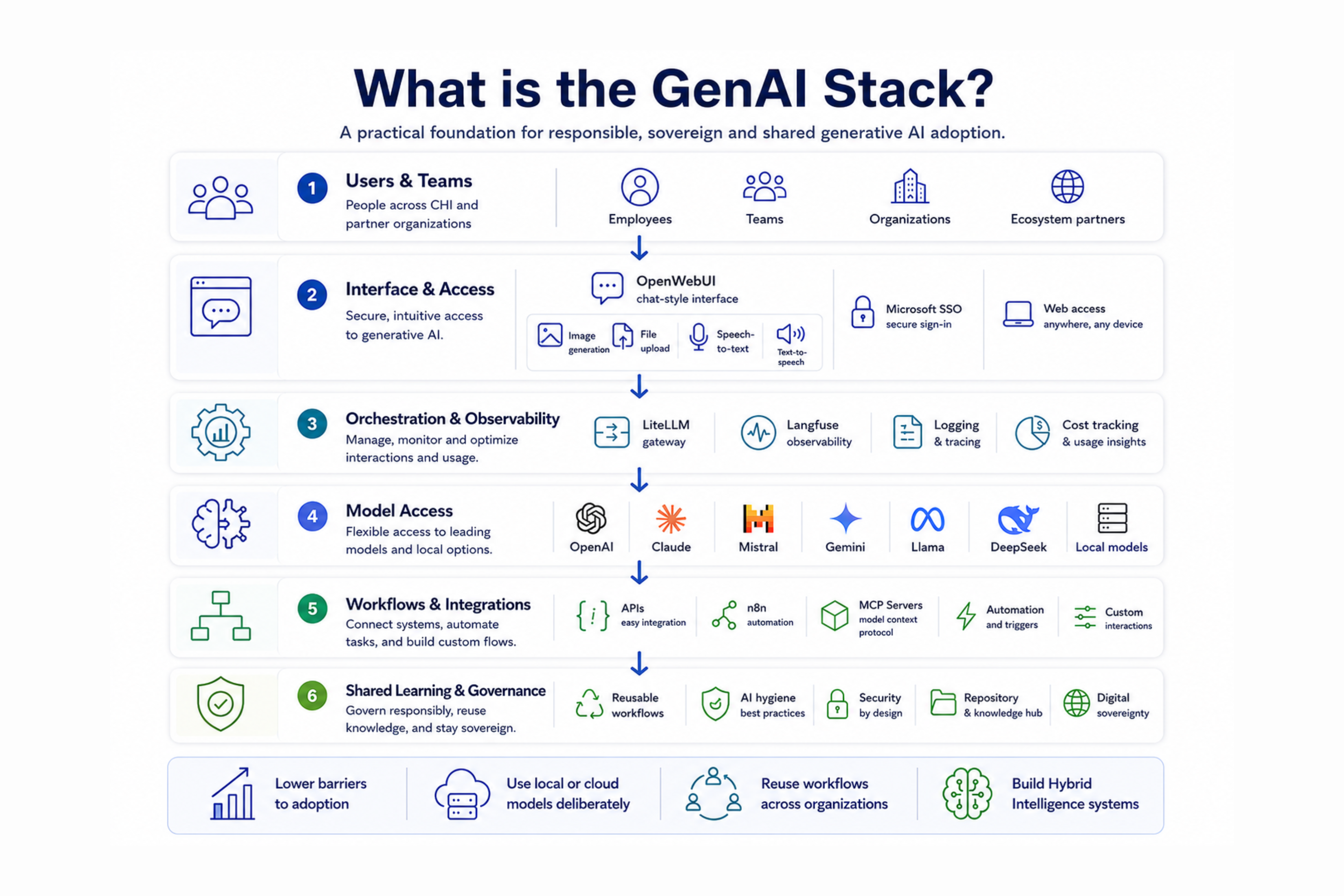
Figure: What is the GenAI Stack?
Why GenAI Stack?
Many organizations want to use generative AI, but lack a clear way to get started safely. The GenAI Stack provides a practical entry point.
It brings together the basic components needed for responsible AI adoption: access to models, secure use, workflow design, observability, reuse, and guidance on when to use local, cloud-based or larger models.
A key strength of the GenAI Stack is that it is currently built on open-source components such as OpenWebUI, LiteLLM and Langfuse. This makes the stack more transparent, adaptable and accessible. The underlying tools are developed, tested and reviewed by large developer communities, which helps improve quality, security and reliability over time.

Figure: The 6 principles of why to use the GenAI Stack.
The stack itself does not have to be a costly closed product. The basic setup can often be built from free and open-source components, while organizations connect their own APIs, models, hosting and services. This lowers the barrier to adoption while giving organizations more control over how AI is used.
The ambition is not simply to introduce another AI tool. The ambition is to help organizations build capacity and knowledge, share what works, and make better decisions about how AI should be used. It also supports a shared AI literacy approach, helping organizations move away from opaque black boxes and vendor-dependent AI adoption.

Figure: Visualization of the architecture.
What the initiative enables
The GenAI Stack helps organizations:
- adopt generative AI in a more structured way
- reduce dependency on closed or unclear systems
- choose models and compute more deliberately
- test when smaller or local models are sufficient
- use cloud resources only when needed
- develop reusable workflows
- document barriers and lessons learned
- build shared AI practices across teams and organizations
- connect AI adoption to Hybrid Intelligence principles

Figure: Enablement and advantages of using the GenAI Stack.
Digital sovereignty and responsible AI
A central idea behind the GenAI Stack is digital sovereignty.
This means that organizations should understand and control how they use AI: which models are used, where data goes, what workflows are created, how costs develop, and what should be shared or reused.
A sovereign AI approach does not mean avoiding all external providers. It means making informed choices and avoiding unnecessary dependency.
The GenAI Stack supports this by creating a more transparent and modular foundation for AI adoption.
Climate-aware AI
Responsible AI is also about resource use.
Different AI tasks require different levels of compute. Some workflows may be solved with smaller or local models, while others require larger cloud-based models. The GenAI Stack makes this choice more deliberate.
By building climate-aware tools such as EcoLogits into the stack, organizations can make the energy and CO₂ impact of AI use visible to users. This makes it easier to compare models, understand the cost of different workflows, and avoid using more compute than necessary.
The goal is not to stop organizations from using powerful AI models. The goal is to help them use the right model for the right task.
From tools to shared workflows
A major challenge in AI adoption is that useful work often disappears.
Prompts, workflows, automations and lessons learned are created locally, but are rarely stored, shared or improved over time. This means that organizations repeatedly solve the same problems from scratch.
The GenAI Stack therefore emphasizes the goal of reuse and contribution back to the community.
When organizations develop useful workflows, implementation patterns or barrier logs, these should become part of a shared learning system. Over time, this can help build a stronger ecosystem for responsible AI adoption across companies, sectors and public institutions.
Connection to Hybrid Intelligence
The GenAI Stack is a foundation for building Hybrid Intelligence in practice.
Hybrid Intelligence is not just about giving people access to AI. It is about designing systems where humans and AI work together in ways that strengthen human judgment, expertise, learning and responsibility.
The GenAI Stack supports this by making AI use more visible, governable and shareable. It creates the infrastructure and practices needed to move from individual prompting to shared, responsible human-AI workflows.
It also opens the possibility of integrating Hybrid Intelligence evaluation directly into the stack. For example, FERC metrics or a FERC bot could help users reflect on the quality of their human-AI collaboration: whether AI is supporting rather than replacing human expertise, whether workflows preserve human judgment, and whether outputs remain transparent, useful and responsible.
In this way, the GenAI Stack can become more than infrastructure. It can become a learning environment where organizations not only use AI, but continuously improve how humans and AI work together.
Cloud and on-prem deployment
The GenAI Stack can be deployed in different ways depending on the organization’s needs.
Some workflows are best handled in the cloud, especially when speed, scale, managed infrastructure or access to advanced models is the priority. Other workflows may require more control, privacy or local processing. In those cases, an on-premises setup, for example through an AI Box running on a Mac Mini, can keep more of the processing and data handling local.
A central idea is that deployment should be chosen per workflow. Not every task needs the largest cloud model, and not every task needs to run locally. The GenAI Stack makes it possible to combine cloud services and local infrastructure in a more deliberate way.
LiteLLM can act as a shared gateway across both setups, helping route requests to the right models and endpoints. This makes the stack more flexible: organizations can connect cloud APIs, local models, private endpoints and workflow tools while keeping a clearer overview of usage, cost and control.
This supports digital sovereignty, climate-aware AI and responsible deployment by helping organizations choose the right model, compute and infrastructure for each task.

Figure: Two pathways of setup, it’s not a question of either/or, but rather both/and.
Roadmap
1. Build the foundation
Clarify the core stack, the technical setup, the governance principles, and the connection to digital sovereignty and Hybrid Intelligence.
2. Test with organizations
Work with selected companies and partners to test real workflows, understand barriers, and evaluate what can be solved locally, what requires cloud support, and what kind of support organizations need.
3. Operationalize the stack
Turn validated pilots into a usable setup with clear workflows, deployment choices, support structures, AI hygiene practices, and usage, cost and impact tracking.
4. Scale through shared learning
Turn workflows, implementation experiences and lessons learned into reusable resources that can support broader adoption across companies and organizations.
This roadmap is a simplified interpretation of the initiative’s development path. Other activities will naturally sit under each step as the work evolves.
(This roadmap is a simplified view of the initiative’s development path. Additional activities will sit under each phase as the work evolves.)

Vision
The vision is to create a practical and shared foundation for responsible GenAI adoption.
The GenAI Stack should help organizations move beyond hype and isolated pilots. It should make AI easier to adopt, easier to govern, easier to get AI in the hands of the employees(users), easier to share and easier to align with human-centered values.
In the long run, the initiative can contribute to a more sovereign and collaborative AI ecosystem, where companies do not just consume AI tools, but learn, build and share better ways of working with AI.